Kitchen Cabinets Falling Apart? You Probably Bought MR Instead of BWR Plywood
Kitchen Cabinets Falling Apart? You Probably Bought MR Instead of BWR Plywood
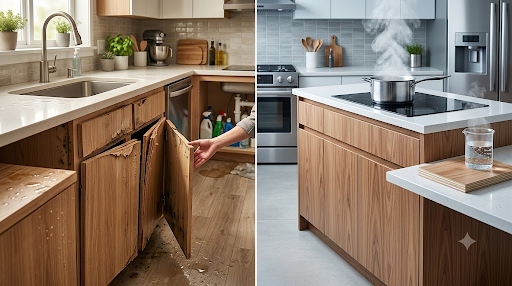
Swollen shutters, peeling laminate, and a musty smell near the sink — if your kitchen cabinets are showing these signs within a couple of years, the plywood grade is almost certainly the culprit. Most homeowners don't realize that the plywood behind their cabinets was never meant to handle kitchen conditions in the first place. It's one of the most common — and expensive — mistakes made during home interiors in Hyderabad.
Here's what's actually happening, and how to make sure it doesn't happen again.
MR vs BWR Plywood: The Difference That Matters
The confusion almost always comes down to two plywood grades that sound similar but perform very differently.
MR Grade Plywood (Moisture Resistant)
MR plywood is bonded using formaldehyde-based adhesives that can tolerate occasional dampness but are not designed for sustained water exposure. It works well for:
- Wardrobes and bedroom furniture
- Living room units away from water sources
- Low-moisture interior applications
The problem is that many carpenters and budget-focused contractors use MR plywood for kitchen cabinets simply because it's cheaper — without explaining the trade-off to the homeowner.
BWR Grade Plywood (Boiling Water Resistant)
BWR plywood is manufactured using phenol-formaldehyde adhesives that are boiled-water tested during production. This makes it significantly more durable against:
- Constant humidity near sinks and dishwashers
- Splashes and spills that MR plywood simply can't absorb repeatedly
- Steam exposure from cooking, which gradually weakens MR-bonded layers
For any surface within a few feet of a kitchen sink, stove, or water pipe, BWR is the only grade that's actually engineered for the job.
Why Kitchen Cabinets Specifically Need BWR Plywood
Kitchens are the most moisture-heavy zone in any Indian home. Between daily water splashes, steam from cooking, humidity from washing utensils, and occasional plumbing leaks, cabinet plywood is under constant low-grade stress.
MR plywood wasn't built to withstand this. Over time:
- Layers begin to delaminate, causing swelling and warping along the edges
- Adhesive bonds weaken, leading to shutters that sag or don't close properly
- Moisture gets trapped inside, creating the musty odor many homeowners notice near the sink cabinet
- Structural integrity drops, shortening the lifespan of the entire kitchen unit from 15+ years down to just 3-5 years
This is why, when visiting any credible plywood store, kitchen-specific applications should always be discussed separately from general furniture plywood.
How to Tell If Your Cabinets Were Built With the Wrong Grade
If you're unsure what grade was used in your existing kitchen, look for these warning signs:
- Swelling along cut edges, especially near the sink or dishwasher area
- Shutters that no longer close flush or have started sagging
- Bubbling laminate or veneer, indicating moisture trapped beneath the surface
- A persistent damp smell even after cleaning
- Visible layer separation at the corners or joints
If two or more of these are present, it's worth having the cabinet base inspected before the damage spreads to adjoining units.
What to Check Before Buying Plywood for Your Kitchen
Whether you're renovating or building new cabinets, don't leave the grade decision to assumption. Confirm these details directly with your plywood suppliers:
What to Check Before Buying Plywood for Your Kitchen
- Ask specifically for BWR grade, not just "waterproof" or "moisture resistant" — the terminology matters and is often used loosely.
- Check for ISI certification, which confirms the plywood has been tested to IS:303 standards for BWR-grade bonding.
- Request the boiling water test result or documentation, especially for bulk kitchen orders.
- Match the grade to the zone — BWR for sink and wet areas, MR is acceptable only for cabinets far from any moisture source.
- Avoid trusting price alone — MR plywood is cheaper precisely because it skips the higher-grade bonding process that BWR requires.
Finding a Reliable Plywood Store in Hyderabad
Given how often this mix-up happens, sourcing from an experienced plywood store near me search isn't enough on its own — the store needs to actually stock verified BWR grades and be transparent about which plywood suits which application.
Plylam Centre in Hyderabad specializes in helping homeowners and contractors choose the correct plywood grade for their specific application, whether it's BWR for kitchens and wet areas or standard grades for other furniture needs. Rather than pushing a one-size-fits-all product, the focus is on matching the plywood to the actual usage zone in the home. You can explore available grades and specifications at plylamcentre.com.
Fixing an Existing MR Plywood Kitchen
If your cabinets are already showing damage, here's the realistic path forward:
- Isolated swelling near the sink can sometimes be addressed by replacing just the affected shutter or base unit, rather than the entire kitchen.
- Widespread delamination across multiple units usually means a full cabinet rebuild is more cost-effective than repeated patch repairs.
- Always rebuild with BWR plywood, especially for the base cabinets and any shutter within splash range of water.
Replacing damaged MR plywood with the same grade again will only repeat the problem within a similar timeframe.
The Bottom Line
Kitchen cabinet failure is rarely about poor carpentry — it's almost always a plywood grade mismatch. MR plywood simply isn't built to survive sustained kitchen moisture, no matter how well it's installed. BWR plywood costs more upfront, but it's the only grade genuinely designed to handle daily splashes, steam, and humidity without breaking down.
Before your next renovation or new kitchen build, confirm the grade in writing, ask for certification, and work with a plywood store that understands the difference between furniture-grade and kitchen-grade plywood.
Frequently Asked Questions
1. What's the main difference between MR and BWR plywood?
MR plywood uses moisture-resistant adhesive suited for dry interior furniture, while BWR plywood uses boiling-water-tested phenolic adhesive designed to withstand constant humidity and splashing, making it the correct choice for kitchens.
2. Can MR plywood be used anywhere in the kitchen?
MR plywood should only be used in kitchen zones completely away from water exposure, such as upper storage cabinets far from the sink. Base cabinets and any shutter near water should always use BWR grade.
3. How do I know if my plywood is genuinely BWR grade?
Ask for ISI certification confirming IS:303 compliance and request boiling water test documentation from your supplier before purchase.
4. Why do cabinets swell near the kitchen sink specifically?
The sink area experiences the most consistent moisture exposure from splashes, leaks, and humidity, which MR plywood's adhesive bonds cannot withstand over time, leading to swelling and delamination.
5. Is BWR plywood more expensive than MR plywood?
Yes, BWR plywood costs more due to its higher-grade phenolic bonding process, but it significantly extends the lifespan of kitchen cabinets and reduces long-term repair or replacement costs.
6. Can I repair swollen MR plywood cabinets instead of replacing them?
Isolated swelling near a small area can sometimes be repaired by replacing just that section, but widespread delamination usually requires a full rebuild using BWR plywood to prevent recurrence.
7. Where can I find genuine BWR plywood in Hyderabad?
Plylam Centre in Hyderabad stocks verified BWR-grade plywood suited for kitchen cabinets and wet-area applications. You can check available options at plylamcentre.com.
8. How long does BWR plywood typically last in kitchen cabinets?
When properly installed, BWR plywood kitchen cabinets can last 15 years or more, compared to just 3-5 years for cabinets built with MR-grade plywood in the same conditions.
9. Does laminate quality affect how well plywood resists moisture?
Laminate adds a surface barrier, but it cannot compensate for the wrong plywood grade underneath. If the core plywood is MR grade, moisture will eventually penetrate through edges and joints regardless of laminate quality.
10. What should I ask a plywood store before ordering for a new kitchen?
Specifically, request BWR grade for wet zones, confirm ISI certification, and ask the store to explain which grade suits each part of your kitchen layout rather than assuming one grade fits the entire space.
More Blogs


Turn Your Dream Spaces Into Reality
Narsingi Branch
1-79, Osman Sagar Rd, beside South India Bank, Manchirevula, Narsingi, Telangana 500075
https://goo.gl/maps/31oyDP4wo8zjLhyw7
Contact:
+91 998 999 0105
+91 868 864 6761
Goshamahal Branch
5-5-685, Pink House, Goshamahal, Hyderabad, Telangana 500012


Contact Information:
+91 998 999 0105 +91 868 864 6761 040 2465 4077 040 6674 6699 040 6641 2737 +91 998 999 0104Email address:
Plylam_centre@yahoo.com
© Plylam Centre, All Right Reserved.
Designed and Developed by 10ODM.